Executive-team practice
Does the executive team use AI on its real arbitrations, diagnoses and decision preparation?
 applied business efficiency
Templay / AI transformation for organizations and leadership teams
You may already have tools, pilots or a roadmap. The question now is what actually changes in decisions, workflows and the operating model.
Observed situations
The organizations I meet are rarely starting from zero. They have often launched an AI initiative, tested tools, asked for a roadmap or created a working group.
My work is to read that gap with you: executive practice, collective dynamics, process debt, governance, business model. Then choose where to act first.
Diagnostic
The diagnosis connects what your teams already use with the decisions, workflows and responsibilities that must evolve for AI to genuinely change the work.
In practice, your teams may already be using ChatGPT, Claude, Claude Code, Codex, Gemini, Microsoft Copilot, GitHub Copilot, Cursor, Perplexity or NotebookLM, sometimes as shadow IT. The question is not only the tool: it is what these uses really change in production, decision-making and governance.
Does the executive team use AI on its real arbitrations, diagnoses and decision preparation?
Are teams really changing their workflows, responsibilities and sources of truth?
Many AI transformation analyses stay on one side: strategy, without measuring what architectures genuinely make possible; or technology, without measuring what the organization can really absorb. My dual competence, code + AI and strategy + business, lets me read both at the same time: what can really be built, what must change in the organization, and where to act first.
Not a theoretical report: an actionable reading of what already exists, what blocks progress and what needs structure.
Who uses ChatGPT, Claude, Copilot, Cursor, Gemini or Codex, for which work, with which risk zones.
Where AI can change a real arbitration, a critical workflow or a poorly defined responsibility.
What must be clarified, decided or secured before moving into automation.
Approach
I work with organizations and leadership teams that already understand AI matters, but want to distinguish communication, useful experimentation and real transformation. The diagnosis chooses the entry point; it does not apply a theoretical sequence.
Where is AI already creating value? Where is it still surface usage? Where does process debt block absorption?
The work happens on your real issues: decision, diagnosis, arbitration, strategic preparation and executive-team coordination.
I then move into responsibilities, sources of truth, rituals, workflows and sometimes the business model.
I start with your own AI workbench, because this is where understanding becomes operational.
Executive practice and workflows move in parallel when the market does not leave room for a clean sequence.
I address the absorption context first when disengagement or managerial distrust would block adoption.
AI-augmented thinking on your decisions, diagnoses and arbitrations.
Co-building a shared AI workbench at executive-team scale.
Reshaping workflows, responsibilities or business model under AI pressure.
Strategic analysis or decision preparation on a precise situation.
A mission starts with a precise situation, a transformation objective and a cadence compatible with the executive team's reality.
Trajectory
I have been coding since age 14. I did AI research in 1986, when expert systems were the frontier. At IBM, I contributed to supercomputer projects that led to Deep Blue. In parallel, I developed algorithmic trading robots for BNP in 1993, high-frequency arbitrage between Tokyo, London and New York. This is not nostalgia. It is the starting point: I have never treated AI as a novelty.
I then spent twenty years working with leadership teams on strategy and organizational transformation, first as a Partner at Capco with global investment banks, then by founding Templay in 2008.
In between, I also built. TAATU was one of the first consumer virtual worlds: 500,000 members, partnerships with Coca-Cola, Universal Music and Ubisoft. It was the metaverse, ten years before the word existed. And then it stopped. I learned what you learn inside a technology hype cycle: the distance between the promise and what actually holds.
More recently, I co-founded Nobureaucracy, an AI startup, and served as CEO. It was hard, the trade-offs are real, and the gap between what you imagine and what you ship is structural. I do not mention it as a credential. I mention it because it is exactly what I ask my clients to go through.
Today, I spend two-thirds of my time coding. I build multi-agent systems and test architectures before recommending them. This practice helps recognize what is becoming reliable, useful and solid enough to transform real work.
















I also serve as a board member of Solidarite Logement (housing-based social insertion), Comalso (communication for people with little or no speech) and other non-profit organizations.
Organizational transformation partners
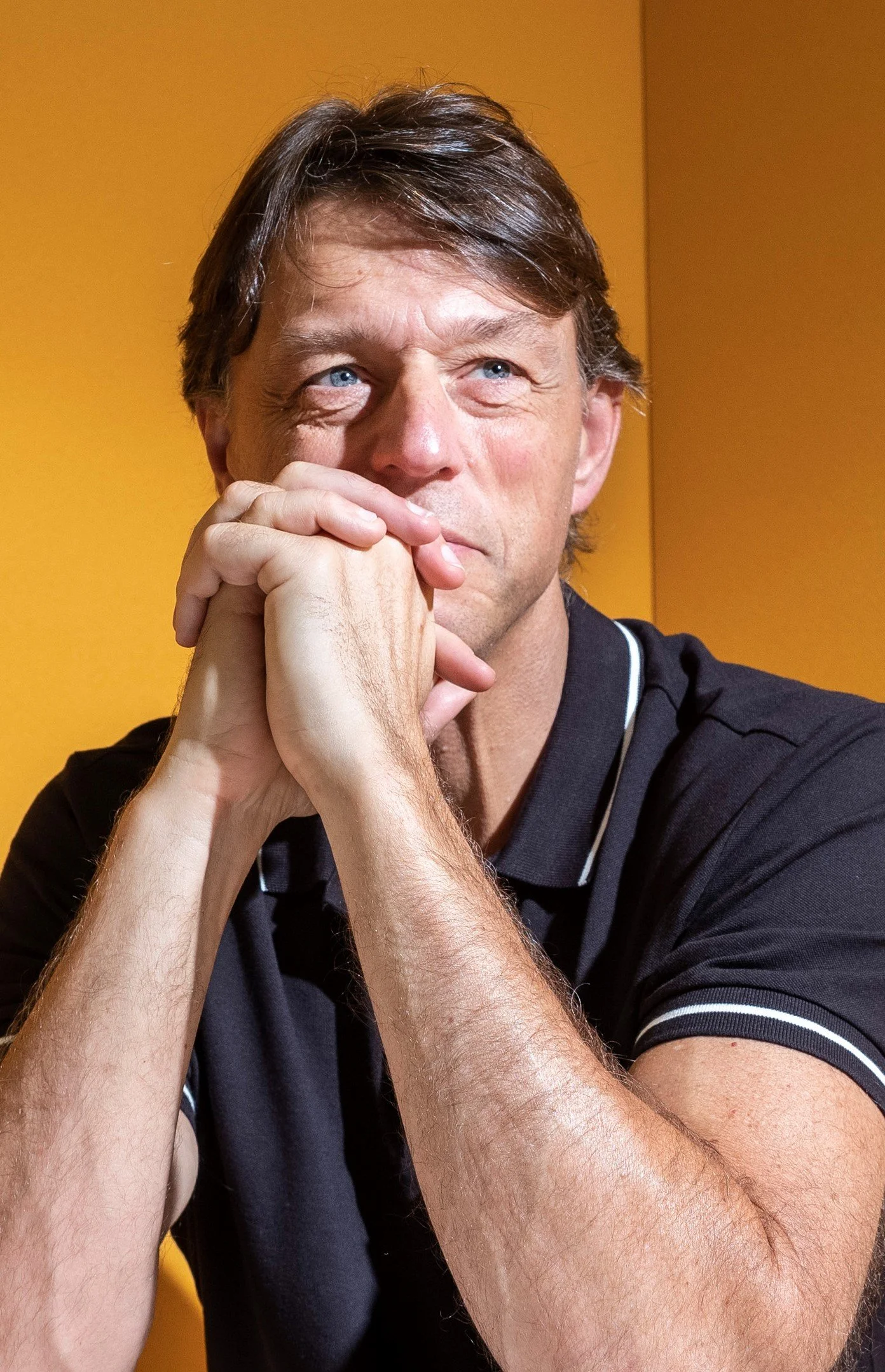
Templay focuses on AI transformation: strategy, executive-team practice, workflows and operating model pressure.
When a mission also requires a strong organizational anchor, I may work with Laurent Ledoux and Equis Leadership: distributed leadership, collaborative governance, autonomy, accountability, decision rituals and collective dynamics. Laurent and I have known, challenged and worked with each other for more than fifteen years. In each case, the collaboration model is explicit: scope, points of contact, responsibilities and collaboration mode.